While ships’ environmentally hazardous wash water is discharged into the Baltic Sea, shipping companies quickly reach breakeven on their scrubber installations, the purification devices that wash out exhaust gases. At the same time, scrubber manufacturers are increasing their revenues through misleading marketing, and refineries are making a profitable business out of a residual product that has a very limited market. Private economic interests are benefiting at the expense of our sensitive inland sea.
Lucrative for shipping companies
Reduced sulphur emissions to the air from shipping are positive for air quality but have led to an unfortunate development where the sea is paying a high price. When regulations to reduce sulphur emissions from ships were tightened, momentum was created that could have driven the development towards the use of more environmentally friendly fuels in shipping. However, with an on-board purification device that washes the exhaust gases with seawater, known as a scrubber, ships were able to continue running on cheap, environmentally hazardous heavy fuel oil (HFO) instead of switching to more expensive, cleaner fuels.
Installing a scrubber has proven to be a profitable alternative for shipping companies. Researchers have shown that the investment in the scrubber breaks even after just 2-5 years – mainly because shipping companies can continue to run on cheap heavy fuel oil – instead of switching to cleaner alternatives. From a global perspective, calculations show that by the end of 2022, just over half of the ships with scrubbers, which continued to run on cheaper heavy fuel oil (HFO), had an economic surplus of just over SEK 50 billion.

Scrubber manufacturers sell the technology using false marketing
The Swedish company Alfa Laval is one of the largest suppliers [1] of scrubbers and is profiting from increased sales. On its website, Alfa Laval sells scrubber technology using the following argument:
“Fuel prices are unpredictable, but high-sulphur fuel is consistently less expensive than low-sulphur options. With a PureSOx scrubber, you can leverage the price difference while reducing SOx emissions to the equivalent of low-sulphur fuel. You get sustainable fuel economy – and a rapid return on your SOx scrubber investment.”
It is true that scrubbers reduce sulphur emissions from ships into the air – and that shipping companies get a quick return on their investment. But the company doesn’t mention the toxic and environmentally harmful wash water that is simultaneously discharged into the sea. Alfa Laval attracts shipowners with “sustainable fuel economy”, which is true from a business perspective. But for the marine environment, the use of scrubbers is anything but sustainable. Huge volumes of toxic water are being discharged into the Baltic Sea, damaging marine life in a sea that is already under severe pressure from overfishing, eutrophication and climate change. The cost is high for both the environment and, in the long run, for the economy. Alfa Laval’s decision to omit important information and facts about the negative impact of the technology on the marine environment can be seen as false advertising.

[1] Alfa Laval is the third largest manufacturer of scrubbers in the world. The 10 largest scrubber manufacturers also include Finnish company Wärtisilä and Norwegian company Yara. Source: Statistics downloaded on 28 October 2025 from the classification society DNV (Det Norske Veritas).
Large increase in environmentally hazardous wash water
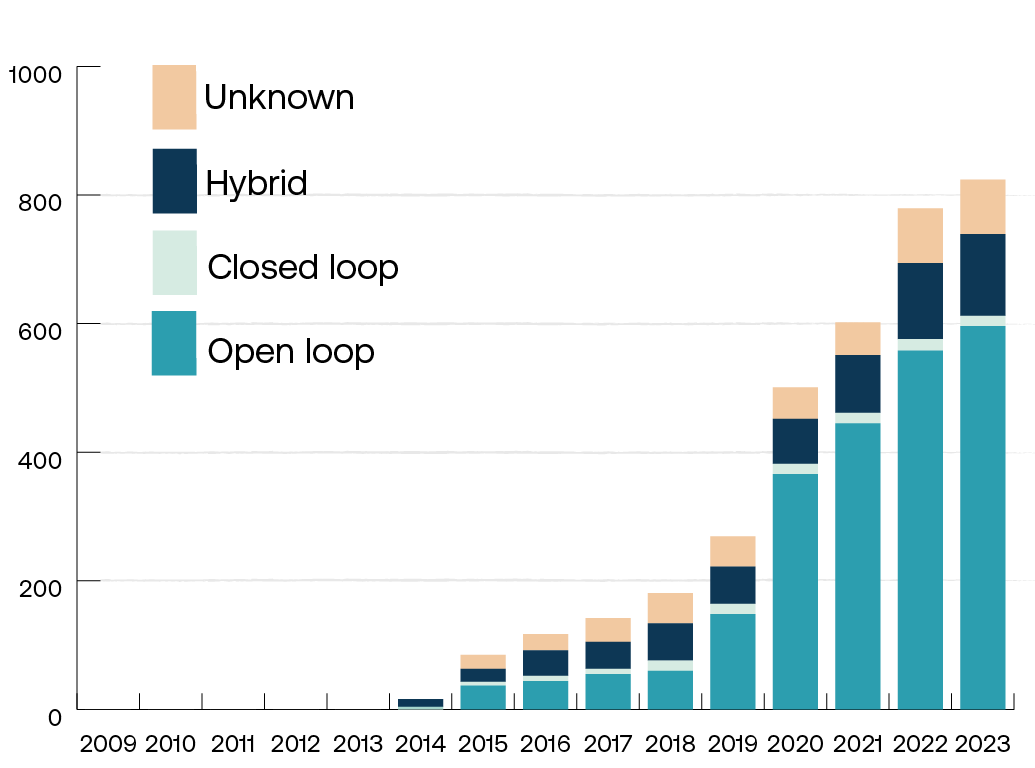
The number of ships with scrubbers installed, operating in the Baltic Sea has increased from 19 ships in 2014 to just over 800 ships in 2023. When stricter regulations on emissions to air were introduced in 2020, the number of scrubbers in the Baltic Sea increased significantly. Approximately 80% of the scrubbers on ships are so-called open scrubbers, i.e. scrubbers that discharge wash water directly into the sea (Fig. 1).
With the increase in the number of scrubber-equipped ships, the volume of wash water discharged into the Baltic Sea is also increasing dramatically. Data from HELCOM shows an increase from 66,000 tonnes in 2010 to 293 million tonnes of wash water in 2023, i.e. more than 4,400 times more polluted water.


Figure 2. Discharge patterns for wash water from open scrubbers in 2010, 2015 and 2023. The corresponding volumes were 66,000 tonnes (2010), 75 million tonnes (2015) and 294 million tonnes (2023). The red colour indicates the amount of wash water – darker colours correspond to larger amounts of wash water. Source: HELCOM
High costs for the environment
Calculations show that the costs of the deterioration of the marine environment, as a result of wash water discharges during the period 2014–2022 amounted to just over SEK 7 billion. The societal costs are estimated by combining the results of other studies on willingness to pay with the estimated toxicity of metals and PAHs (carcinogenic and persistent substances) commonly found in wash water from scrubbers. The wash water, which has been shown to be highly toxic even in small quantities, can cause increased mortality in plankton and disrupt the reproductive capacity of plankton communities. This can have effects on other animals in the ecosystem that feed on plankton, such as various fish species.
But it is not only scrubber discharge water that can cause environmental damage and costs to society. If a ship equipped with a scrubber to run on heavy fuel oil (HFO) runs aground, the heavy fuel oil can leak out and cause major damage to the environment. A recent example of this is Marco Polo, where the oil spill following the ship’s grounding in 2023 has caused elevated levels of environmental toxins in blue mussels, which risks being transferred to both birds and fish that feed on mussels. The clean-up costs following the grounding are also extensive. After more than a year and a half, the bill continues to grow – and so far amounts to 64 million SEK that the Swedish Civil Contingencies Agency (MSB) has paid out to the affected municipalities.
Ban on closed scrubbers in Swedish territorial waters delayed
Since 1 July this year, it has been prohibited to use open scrubbers in Swedish territorial waters. However, closed scrubbers may continue to be used within territorial waters until 2029. Open scrubbers discharge wash water directly into the sea, while closed scrubber systems discharge smaller amounts of water – albeit with high concentrations of environmental toxins.
The decision to wait until 2029 to introduce a total ban on closed scrubbers is based on economic arguments – the government considers that those who have invested in more expensive closed systems should be given time to recoup their costs. However, a total ban on emissions from all types of scrubbers in Swedish territorial waters would have been both clearer and more effective in protecting the marine environment.

Economic gains – ecological losses
There are strong financial incentives for several stakeholders to continue using scrubbers – shipping companies, manufacturers and refineries all benefit from the current system. But the gains are short-term. The sea and its inhabitants pay the price, and ultimately so do we.
For the sake of the Baltic Sea, a clear stance is needed: stop the discharge of scrubber water before the damage becomes irreversible.

In the next article, we explore the legal aspects of scrubbers, addressing the overarching question of whether there is already legal support for banning dischargers from scrubbers throughout the Baltic Sea.
In BalticWater’s first article on scrubbers, you can read more about the background to the use of scrubbers and the effects of their toxic wash water on the marine ecosystem.