Fish stocks in the Baltic Sea are at historically low levels. Once valuable food fish such as Baltic cod and salmon have largely disappeared from large parts of the sea and are now subject to fishing bans. At the same time, extensive industrial trawling for herring and sprat continues, with a significant proportion of the catch being ground up for animal feed rather than used as food.
A new report from BalticWaters, written by economist Stefan Fölster, shows that this large-scale fishing has become a loss-making venture for the Finnish economy, just as it has in Sweden. When the value of the fishing is weighed against Finland’s costs for subsidies, tax exemptions, administration and carbon dioxide emissions, a net loss of around 5 million euros per year emerges.
The costs consist of both direct subsidies to the industrial fishing sector and tax exemptions on fuel, which result in the state losing out on revenue. In addition, there are expenses for the control, monitoring and regulation of fishing. At the same time, the industry causes significant carbon dioxide emissions – a climate cost that is often overlooked in the public debate.
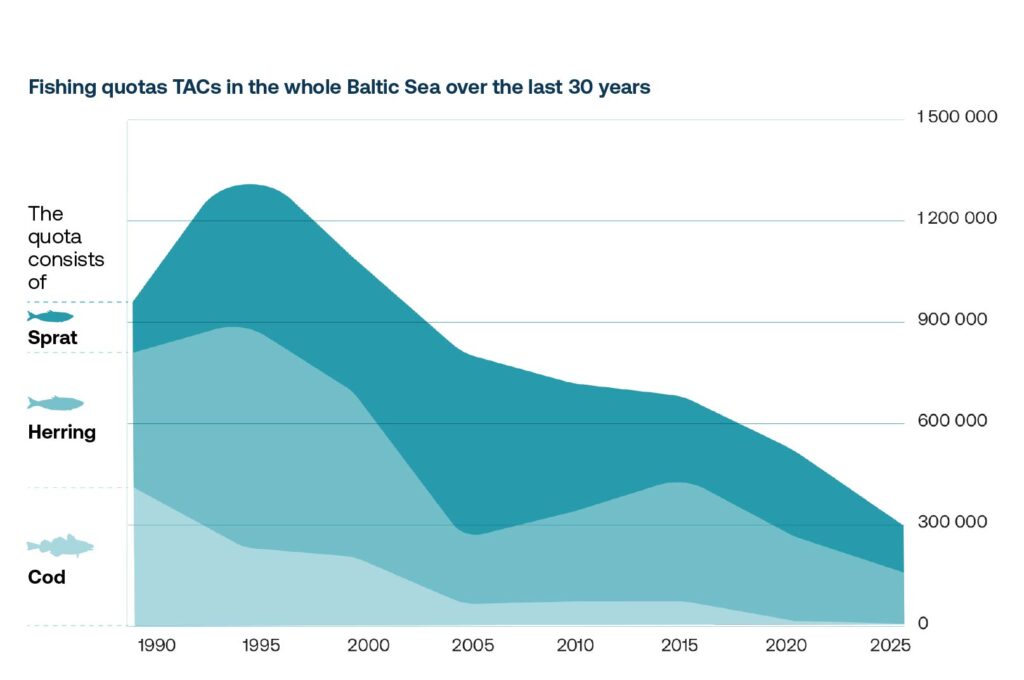
Large-scale industrial fishing also risks exacerbating the situation across the entire Baltic Sea ecosystem. Herring and sprat are key prey species for predatory fish such as cod and salmon. When large quantities of these smaller fish are caught in industrial fishing, the food supply for predatory fish is reduced, causing these stocks to weaken further. The result is that valuable food fish cannot recover.
Another effect of industrial trawling is that fish stocks are stressed, leading to a decline in the quality of the fish. This means that even more of the catch can only be used as feed, which in turn displaces coastal food fisheries, reduces national value creation and lowers food security.
Same sea, same outcome
In a previous report for BalticWaters, Stefan Fölster analysed large-scale fishing in Sweden and reached similar conclusions: in Sweden, too, industrial fishing results in a net socio-economic loss, estimated at around 205 million kronor per year.
Finland and Sweden share the Baltic Sea as a common body of water, manage largely the same fish stocks and are the two largest quota holders. It is therefore natural that the countries face similar challenges. In both cases, short-term political decisions can hinder the long-term recovery of fish stocks.
The EU Council of Ministers has on several occasions set fishing quotas that exceed ICES’s scientific recommendations. When the EU’s fisheries and agriculture ministers decided on the 2026 quotas in October, the Finnish government, led by Minister for Agriculture and Forestry Sari Essayah (KD), voted in favour of increasing fishing quotas, whilst the Swedish government, led by Minister for Rural Affairs Peter Kullgren (KD), voted against. This difference shows that the countries approach the issue differently – despite sharing the same sea.
The socio-economic benefits of an active fisheries policy
A more long-term fisheries policy is essential if fish stocks are to recover and begin to generate greater value for society. If large-scale trawl fishing is restricted to being permitted on only around a quarter of the Baltic Sea’s surface area, and is allocated a lower quota equivalent to approximately 30 per cent of current quotas, this will free up space for coastal fishing and protected areas where fish can grow. Such a shift would yield clear benefits:
- fish stocks would be strengthened
- more fish could be used as food rather than feed
- national food security would be improved
- coastal communities and local businesses would be strengthened
- greater economic value would be created in the value chain (catch-processing-export)
Fölster’s calculations show that such a transition in Finland could generate socio-economic benefits of almost one billion euros over 50 years if fisheries are steered towards sustainability. The corresponding figure for Sweden is 8.6–13.9 billion kronor.
Overall, the analysis shows that both Sweden and Finland have much to gain from a more long-term fisheries policy that prioritises coastal fishing over large-scale industrial fishing. Such an approach strengthens fish stocks, increases the value of the catch and builds a modern, nationally based value chain from catch to processing and export. This improves food security, strengthens coastal communities and creates greater socio-economic value.
As the countries manage the same stocks, closer Swedish–Finnish cooperation is also required. A policy that focuses on stock recovery and limits large-scale fishing would both improve the environment in the Baltic Sea and secure the region’s future supply of edible fish.
Policy recommendations:
1. Limit or pause large-scale trawl fishing to allow fish stocks to recover.
2. Introduce zoning with protected areas and reallocate quotas to inshore fisheries.
3. Strengthen fisheries management through better monitoring, tailored quotas and closer cooperation between Sweden and Finland.

The brief in short
A new report shows that large-scale pelagic trawl fishing in Finland results in a net socio-economic loss of around 5 million euros per year. Furthermore, a large proportion of the catch is used for fishmeal and animal feed rather than for human consumption. If, instead, fish stocks in the Baltic Sea are allowed to recover and coastal fishing for food fish is prioritised, significant socio-economic value can be created through the processing of the catch in Finland. Fölster’s calculations show that such a transition could generate up to one billion euros in socio-economic value over 50 years.