Baltic sprat
Sprat is the small cousin of the herring. They are often confused with each other, but unlike the herring, the sprat has sharp scales on its belly. Just like the herring, it is found in all sea areas around Sweden and lives mainly in shoals out at sea.

Sprat.
The role of sprat in the ecosystem
Like herring, sprat plays a central role in the Baltic Sea ecosystem. It feeds on zooplankton and is preyed upon by larger fish such as cod. There is much we do not know about sprat, such as how it migrates in the Baltic Sea and what its population structure looks like. Despite this, sprat in the Baltic Sea is managed as a single large stock.
Fishing for sprat in the Baltic Sea
Poland and Sweden have the largest quotas for sprat in the Baltic Sea, with Sweden’s quota accounting for approximately one-fifth of the total quota. In 2024, industrial fishing accounted for just over 90 percent of the Swedish catch of herring and sprat – catches that are turned into fishmeal and oil, and used as animal feed in salmon farms and chicken farms.
Large-scale fishing for herring and sprat is carried out through so-called mixed fishing, where it is difficult to distinguish between the two species. The difficulty in distinguishing between the species risks misreporting of catches – data that will then form the basis for quotas in future years. The issue has been highlighted by the International Council for the Exploration of the Sea (ICES) for several years, but the extent of the problem remains unknown.
Despite the lack of information about sprat, it is managed as a single large stock in the Baltic Sea. However, as with herring, there may be several populations in the inland sea – groups of individuals of the same species that may differ in terms of genetics, appearance, and behavior. It is important to increase knowledge about sprat so that it can be managed in a sustainable way.
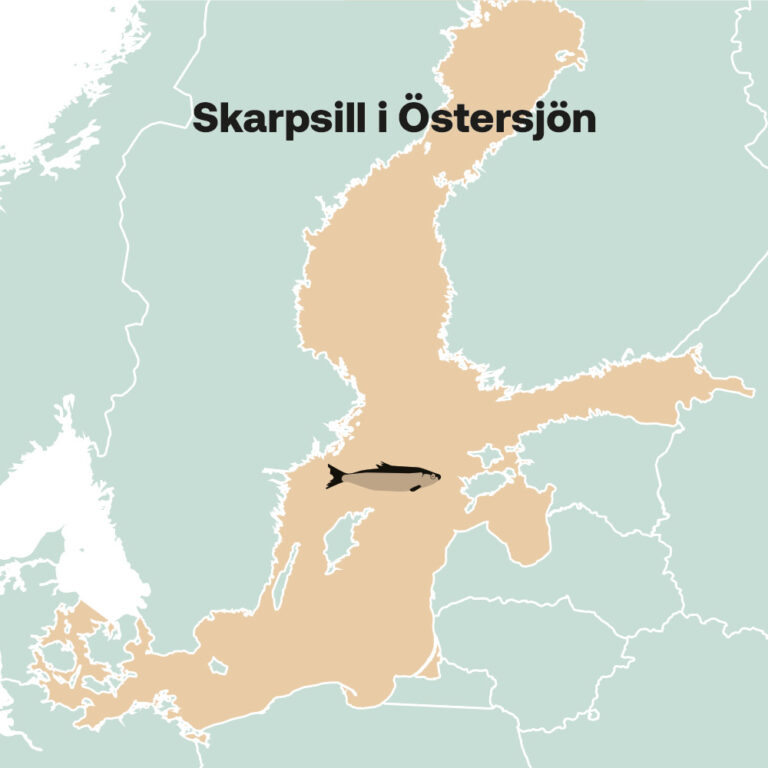
Sprat is managed as a single large stock in the Baltic Sea.
Sprat spawning
Spawning takes place during spring and summer in open water, around the deep sea basins in the central Baltic Sea. The sprat is a so-called serial spawner, which means that it spawns several times during the same season. The sprat’s eggs float freely in the water, unlike the herring, which lays its eggs on a surface. For the eggs to float, the salinity must be at least 5–6 per mille. After a few days, small sprat larvae hatch.
Sprat in the Baltic Sea and other seas
Like other species, sprat has adapted to the conditions in the Baltic Sea. For example, spawning in the Baltic Sea mainly takes place between May and August, while spawning in the Adriatic Sea is concentrated in November and December. The start and duration of spawning are determined by water temperature, but also by food availability. However, there is much we do not know about the herring’s small relative in the Baltic Sea.