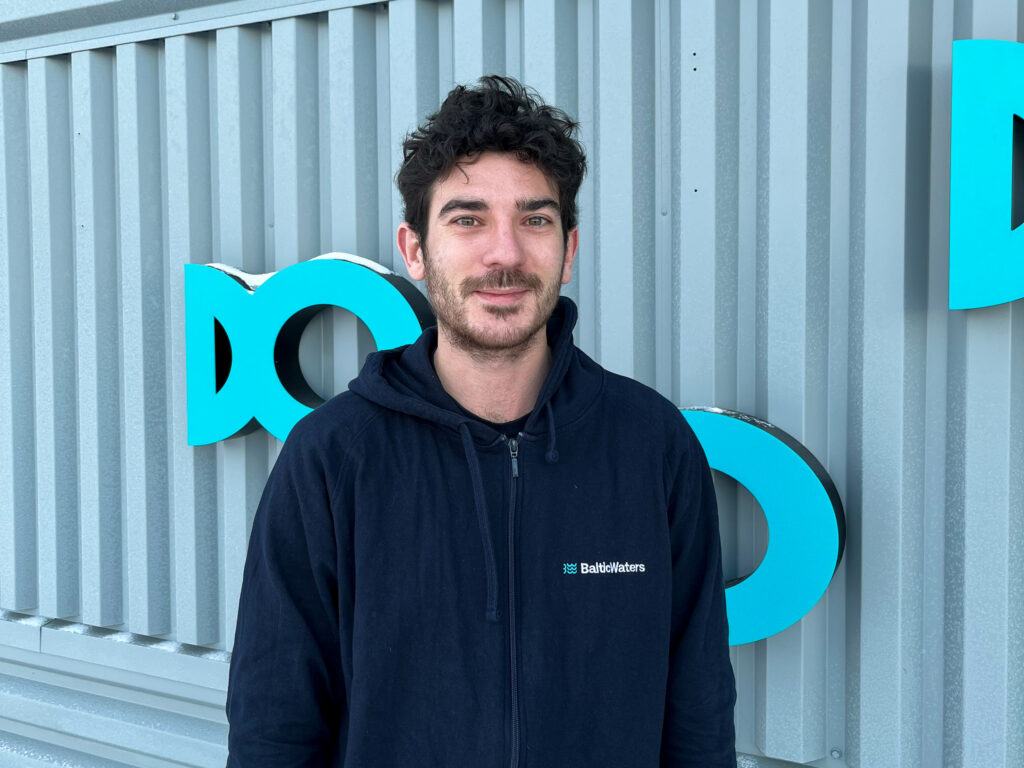
BalticWaters’ project ReCod – release of small cod in the Baltic Sea is facing an exciting new start at the foundation’s new fish research laboratory in Studsvik. Vincent Néron is new to the Baltic Sea, but has extensive experience of various aquaculture projects. He is now leaving France behind and taking over the baton as the new project manager for ReCod.
Vincent’s interest in aquaculture was awakened at an early age. But what is now a commitment to fish biology and the restoration of endangered stocks began at the other end – at the dinner table.
“It was gastronomy that led me into fish farming. I have always loved fish. My family comes from the coast of Brittany, where fish and shellfish have always been an important part of life,” he says.
Vincent is trained in aquaculture and has previously worked with the breeding of several different species. His path to Studsvik and the Baltic Sea has included fish farming in Canada, studies of the early life stages of eels in Denmark, and work on various restoration projects in France.
As the new project manager for ReCod, Vincent sees an opportunity to combine practical work with fish farming with research and restoration work. He takes over the role from Ellen Schagerström, who is now returning to her research position at the University of Gothenburg.
“Being able to breed fish from scratch and then release them back into the wild to strengthen wild stocks is very motivating. It is still a relatively young research field and we do not yet fully understand the extent of the impact that restocking can have. Being involved in investigating this is incredibly exciting,” he says.
With the launch of BalticWater’s new fish research laboratory, ReCod is entering an exciting new phase. During the project’s first year, methods have been developed for keeping cod, hatching cod larvae, and releasing them at selected locations in the Baltic Sea. The next challenge will be to raise cod larvae into small fish for release. The goal is to find the age and size of fish that is best for release.
“The early stages of life are crucial. If we get the conditions right there, the chances of success for the rest of the process increase. The first few months will be very much about testing, adjusting, and building routines that will last,” says Vincent.
The first step will be to get the new systems up and running and build up expertise in the project team, where Vincent will be working alongside Jonnie, so that the team is ready when it is time to bring in the first parent fish and hopefully hatch new healthy cod larvae.
“Seeing the first larvae hatch and thrive will be a big moment. Then we’ll know we’re on the right track,” says Vincent.
We warmly welcome Vincent to the foundation and look forward to following ReCod’s next steps!
Five quick questions:
Name: Vincent Néron
Previous roles: Worked on various research projects in aquaculture, including eel, maquerel, and lobster
From: Brest, France
Favorite species: European eel, one of the sea’s greatest mysteries!
First thing I will do in my new role: Get to know the project and lay the groundwork for the next phase of ReCod.

About ReCod
ReCod – release of small cod in the Baltic Sea is one of BalticWater’s largest and longest-running projects. The work began in 2020 at the Ar research station on Gotland, where we conducted trials involving the release of 4–6-day-old cod larvae at several locations along the east coast to investigate whether the larvae survive and are able to establish themselves.
In total, almost 1,000 cod have lived at the station, and together they have produced nearly 2.5 million cod larvae that have been released into the Baltic Sea. If the experiments are successful, there is a possibility of re-establishing cod in more locations in the Baltic Sea, which will increase the chances of preserving and protecting the unique eastern stock.
From 2025, ReCod runs at BalticWater’s new fish research laboratory in Studsvik, outside Nyköping. Here, the cod larvae will initially be fed until they are 2–3 cm in size, and then to larger fish for release and research. The aim is to find the age and size of fish that have the best chance of surviving in the wild.
ReCod is being carried out and financed by BalticWaters, with support from Uppsala University and other partners.