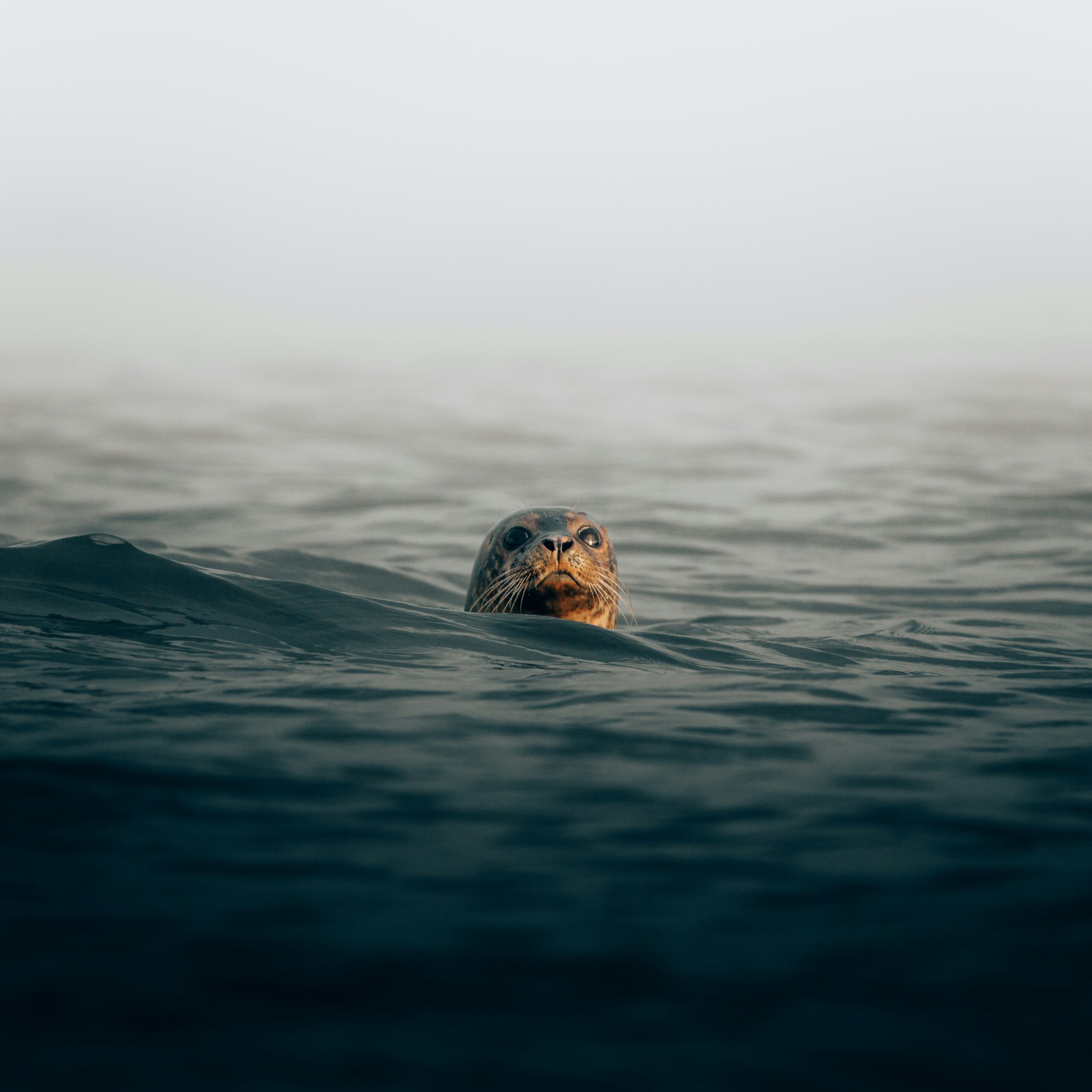
In 2024, the BalticWaters-funded project The Impact of Industrial Trawlers on Coastal Ecosystems was launched. Now halfway through the project, researcher Agnes Olin gives us an update on what has happened and what remains to be done.
There has long been speculation that the lack of large herring in the open sea may be a driving force behind the increasing presence of gray seals and cormorants in the inner archipelago. Coastal fishermen, administrators, and researchers have pointed to large-scale industrial trawling as a possible cause. But despite the topicality of the issue, there is still a lack of scientific studies showing what the actual connections are. Agnes Olin, a researcher at the Department of Aquatic Resources at SLU, is now working to fill this knowledge gap.
The project, which started in 2024, aims to investigate whether gray seals and cormorants are really moving closer to the coast due to reduced availability of herring out at sea, why this is happening, and how their presence affects coastal ecosystems.
– We are looking at the entire chain of causes – from large-scale trawling in the open sea down to what is happening in coastal plant and animal communities, says Agnes.

From Industrial Trawling to Coastal Ecosystems
The project is divided into two main parts. The first investigates whether increased predation pressure from gray seals and cormorants along parts of the coast could lead to a so-called trophic cascade (see “Project Hypotheses” below). Here, census data on gray seals and cormorants is combined with test fishing data and vegetation mapping from SLU’s long-term coastal monitoring.
– There are areas that are test fished year after year along the entire coast. This gives us detailed information about which species are present, how many of each species are caught, and how large they are, explains Agnes.
The second part of the project is about understanding the movement patterns of gray seals and cormorants. Here, everything from observations in the Artportalen to data on seal blubber thickness from the Swedish Museum of Natural History is used to see how the predators’ behavior and condition change over time.
Project Hypotheses
The project investigates the hypothesis that intensive trawling for herring can trigger a trophic cascade in the coastal ecosystem. When the supply of large herring in the open sea decreases, gray seals and cormorants are forced to seek food among coastal predatory fish. When the number of predatory fish declines, the number of sticklebacks increases, which in turn leads to fewer small grazers. With fewer grazers, the amount of filamentous algae increases, which degrades both habitat and water quality and exacerbates the symptoms of eutrophication. If, on the other hand, fishing is sustainable and herring stocks are abundant and viable, gray seals and cormorants do not need to seek food near the coast. This reduces the pressure on coastal predatory fish, which benefits the grazers and keeps filamentous algae in control.
Data Collection Transitions into Analysis
One year after its launch, the project is now entering an exciting phase where data collection is transitioning into analysis. The project only uses existing historical data, and a lot of time has been spent collecting and structuring data from various sources.
– It takes a long time, especially when different people have collected data in different ways. But that part is largely over, and we can finally focus more on analysis, says Agnes.
Although the analyses are still at an early stage, certain patterns are beginning to emerge. In an area in Blekinge, where the data set is particularly extensive, the researchers have been able to see that an increase in cormorants coincides with declines in perch and pike, increases in sticklebacks, and a slight increase in filamentous algae and a decrease in complex bottom vegetation.
– This is the pattern we expected based on our hypotheses, says Agnes, but she emphasizes that it is still too early to draw any conclusions.

The next step is to analyze other coastal areas to see if similar patterns exist there, perhaps completely different correlations can be seen in other places. The researchers will also begin a closer analysis of the movement patterns of gray seals and cormorants in relation to large-scale fishing.
– We are already seeing clear signs of movement into the Stockholm archipelago, both in observations of gray seals in Artportalen and in counting data from cormorant colonies, but so far we do not know what is driving the pattern. Other factors are certainly also at play, especially for cormorants, says Agnes.
The project is expected to contribute important knowledge for both the marine environment and management. By providing a clearer understanding of how large-scale trawling affects predators, fish stocks, and ecosystems, the results can be used as a basis for decisions on fishing regulations, protection of sensitive areas, and long-term management of the Baltic Sea coastal ecosystem.
We look forward to following the project’s continued work and the insights it can provide about the Baltic Sea’s coastal ecosystems!

More About the Project
The project “The impact of industrial trawlers on coastal ecosystems” is being carried out at the Department of Aquatic Resources, Swedish University of Agricultural Sciences, and will continue until 2026. Through BalticWater’s program to fund research projects and pre-studies, the project has been granted SEK 974,899 in funding to support the implementation of the scientific study. You can read more about the five other projects that have been awarded funding in the article Six new research projects for a living Baltic Sea.
Would you like to know more about how the project started?
In 2024, BalticWaters published an initial article presenting the background to the project in more detail and explaining why it is needed. You can find it here.